

Custom Shopify apps solve the bottlenecks that off-the-shelf tools can’t.
They automate tasks, streamline workflows, support complex pricing or subscriptions, and integrate with CRMs or ERPs.
Instead of forcing your business to fit Shopify’s defaults, custom apps adapt the platform to your exact operations, improving performance, control, and scalability as you grow.
Why Custom Shopify Apps Are Transforming E-Commerce
Custom Shopify apps are reshaping how modern e-commerce stores operate.
Instead of relying on one-size-fits-all solutions, businesses are increasingly choosing tools that match their exact workflows, challenges, and growth goals.
To understand why, it helps to see how custom apps differ from public, marketplace apps.
This difference in control, performance, and precision is exactly why merchants are turning to custom development, especially as operations grow more complex.
 Creating a custom Shopify app starts with establishing a solid foundation, one that supports scalability, reliability, and long-term performance.
This process brings together Shopify’s native tools and modern development frameworks to deliver apps that can grow alongside your business.
Creating a custom Shopify app starts with establishing a solid foundation, one that supports scalability, reliability, and long-term performance.
This process brings together Shopify’s native tools and modern development frameworks to deliver apps that can grow alongside your business.
 Custom Shopify apps do more than add features, they remove limitations.
They give merchants the ability to shape Shopify around their business instead of shaping the business around Shopify.
For many stores, this becomes the turning point: the moment they shift from working within constraints to scaling with confidence.
Custom Shopify apps do more than add features, they remove limitations.
They give merchants the ability to shape Shopify around their business instead of shaping the business around Shopify.
For many stores, this becomes the turning point: the moment they shift from working within constraints to scaling with confidence.
 Not every business has the capacity, or the desire, to build and maintain custom Shopify apps in-house.
Outsourcing removes complexity, reduces operational risks, and allows merchants to focus on growth instead of managing technical tasks.
A reliable development partner can turn app creation from a burden into a strategic advantage.
Not every business has the capacity, or the desire, to build and maintain custom Shopify apps in-house.
Outsourcing removes complexity, reduces operational risks, and allows merchants to focus on growth instead of managing technical tasks.
A reliable development partner can turn app creation from a burden into a strategic advantage.
Quick pointers for clarity:
- Purpose-built workflows that eliminate manual tasks
- Seamless integrations with your existing tools
- Faster performance and fewer compatibility issues
- Full control over features, updates, and scalability
- Tailored customer experiences that drive retention
Why Custom Shopify Apps Are Transforming E-Commerce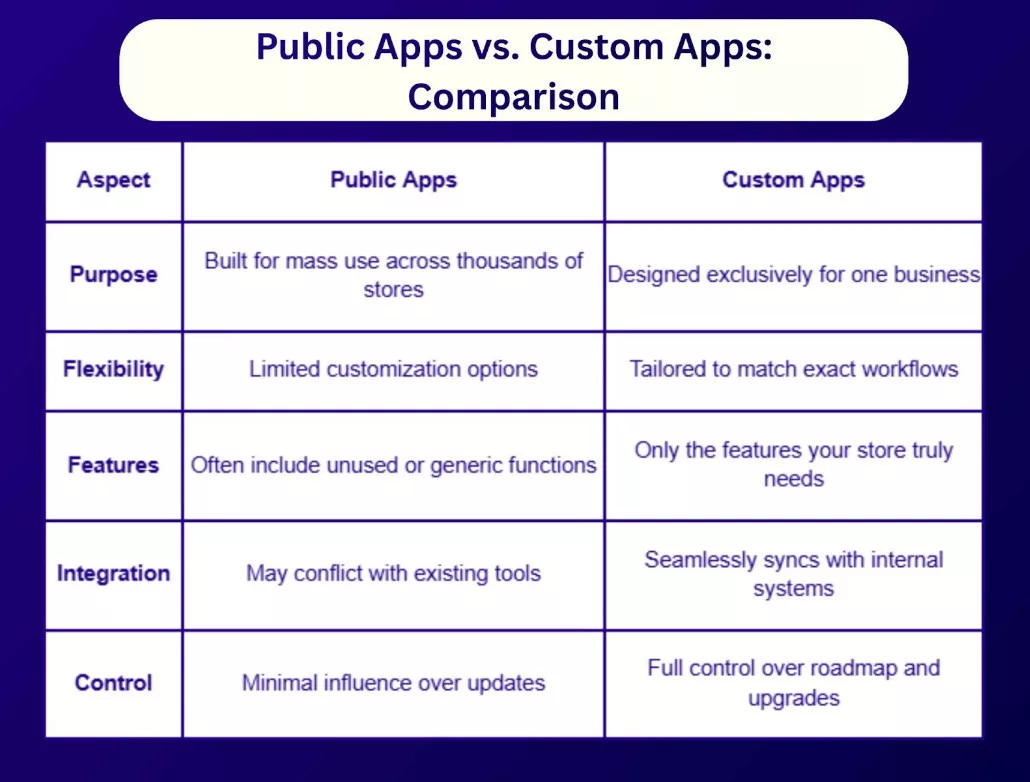
Limitations of Public Apps
Public Shopify apps are useful during early stages, but they’re built for broad usage. Their generic feature sets, compatibility issues, and limited flexibility often create friction for scaling businesses. As workflows expand, these apps can introduce bottlenecks rather than solve them.Benefits of Custom Apps
Custom Shopify apps function like tailored tools engineered around your daily operations. They automate repetitive tasks, support advanced business logic, and integrate with specialized systems such as CRMs, ERPs, fulfillment platforms, or custom databases. Instead of forcing your store to adapt to a pre-built tool, the tool adapts to you.The Point Where Custom Becomes Essential
A custom app becomes essential when your store reaches any of these tipping points:- Standard apps can’t manage complex subscriptions, bundles, or B2B pricing models.
- Manual workarounds slow down fulfillment, inventory tracking, or reporting.
- Expansion into new channels requires ERP, CRM, or WMS integration.
- International growth demands specialized tax logic, multi-currency rules, or shipping workflows.
The Building Blocks of a Powerful Custom App
Creating a custom Shopify app starts with establishing a solid foundation, one that supports scalability, reliability, and long-term performance.
This process brings together Shopify’s native tools and modern development frameworks to deliver apps that can grow alongside your business.
From CLI to Remix: Where Development Begins
Every custom Shopify app begins with the right technical foundation, and that starts with Shopify CLI, the command-line toolkit that handles scaffolding, authentication, local development, and extension setup. It streamlines the entire early-stage workflow, allowing developers to focus on building features instead of configuring the environment from scratch. On top of this base, many teams adopt Remix.js, a server-first React framework that excels in routing, data loading, and performance optimization. Remix delivers fast page rendering, stable SEO behavior, and predictable data flows, critical advantages in e-commerce, where milliseconds affect conversions. Its architecture also reduces complexity by unifying backend and frontend logic, making the app easier to scale, debug, and maintain as business needs evolve.Inside the Developer’s Toolbox
A high-quality Shopify app relies on a carefully selected stack. Each layer serves a specific role in ensuring speed, stability, and adaptability:- Backend: Ruby on Rails or Node.js
- Frontend: React for dynamic, responsive interfaces
- APIs: GraphQL for precise and efficient data retrieval
- Storage: MySQL/PostgreSQL for structured data + Redis for caching
- Hosting: Docker and AWS for flexible, secure, scalable deployments
Shopify APIs: A Double-Edged Sword
Shopify’s APIs are powerful and well-documented, but also granular. Large data operations often require multiple API calls, and strict rate limits mean developers must design with care. Techniques like query batching, throttling, and background processing ensure apps stay responsive even under demanding conditions.Beyond Launch: Ongoing Maintenance
A custom app isn’t a one-time build, it’s a living system. Shopify frequently updates its APIs, introduces new rules, and deprecates older endpoints. To keep the app stable, you need:- Regular maintenance
- Version updates
- Performance tuning
- Bug fixes and patching
The Business Case for Going Custom
Custom Shopify apps do more than add features, they remove limitations.
They give merchants the ability to shape Shopify around their business instead of shaping the business around Shopify.
For many stores, this becomes the turning point: the moment they shift from working within constraints to scaling with confidence.
Competitive Advantages of Custom Apps
Custom apps introduce capabilities that drive measurable operational and customer-facing improvements:- Automation that reduces errors by removing repetitive manual tasks.
- Personalized shopping experiences that strengthen retention and long-term loyalty.
- Smooth integrations with CRMs, ERPs, fulfillment tools, and marketing platforms, ensuring data flows effortlessly across the business.
Scaling Beyond Shopify Plus
High-volume merchants quickly reach the limits of public apps. Custom solutions step in to support more advanced requirements:- Multi-location inventory workflows
- Complex subscription or bundle logic
- Tiered B2B or wholesale pricing models
- Specialized shipping, tax, or international rules
ROI That Extends Past Cost Savings
The return on investment is not limited to money saved. Custom apps bring:- Greater efficiency
- Faster operations
- Higher customer satisfaction
- Smoother team workflows
Outsourcing Custom App Development for Peace of Mind
Not every business has the capacity, or the desire, to build and maintain custom Shopify apps in-house.
Outsourcing removes complexity, reduces operational risks, and allows merchants to focus on growth instead of managing technical tasks.
A reliable development partner can turn app creation from a burden into a strategic advantage.
Limitations of In-House Teams
Managing custom development internally often introduces more challenges than solutions:- Recruiting technical staff is costly and time-consuming.
- Ongoing API updates and maintenance require constant attention.
- Smaller teams lose focus when juggling engineering responsibilities instead of business priorities.
How QFN Supports Your Shopify Growth
QFN provides end-to-end Shopify app development designed for real business impact. Our focus is simple: build apps that perform, scale, and integrate seamlessly.- Tailored Features for Your Exact Workflow: No generic add-ons, every feature aligns directly with your operational needs.
- Seamless Integrations Across Your Tech Stack: From CRMs and ERPs to inventory, fulfillment, and marketing tools, everything connects effortlessly.
- Performance, SEO, and Scalability Built In: Apps are optimized for speed, visibility, and the ability to handle growth without disruption.
- Faster Delivery and Reliable Long-Term Support: Using modern frameworks, we ship quickly, and continue supporting you with updates, security, and optimization.